

Sustainable Development Report 2026
Jun 30, 2026
Current Affair 1:
Sustainable Development Report 2026
News:

The Sustainable Development Report (SDR) 2026 is the 11th annual global assessment of progress on the 17 Sustainable Development Goals (SDGs).
It is published by the UN Sustainable Development Solutions Network (SDSN) and includes the SDG Index ranking all 193 UN Member States.
The SDG Index and Dashboards provide an annual assessment of SDG progress covering all 193 UN member states. The SDG Index score is presented on a scale of 0 to 100 and can be interpreted as a percentage towards optimal performance on the SDGs.
New indicators:
This year’s SDG Index incorporates 123 indicators, including 101 global indicators and 22 additional indicators used for the OECD countries’ dashboards. A new indicator from the FAO, on progress towards productive and sustainable agriculture, was added to track progress on SDG 2 (No Hunger).
You cannot measure a broad goal like "Zero Hunger" with just one data point. Therefore, the index uses 123 statistical indicators (metrics) across the goals to measure actual progress. For instance, SDG 2 is measured using multiple indicators: the prevalence of undernourishment, child stunting, child wasting, adult obesity, and now, the new FAO metric on sustainable agriculture.
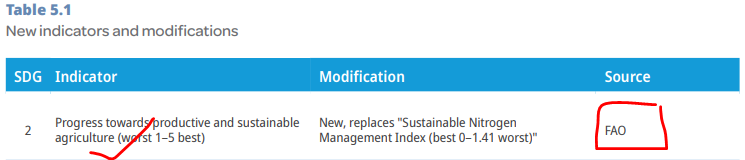
The new FAO indicator "Progress towards productive and sustainable agriculture (worst 1–5 best)" was officially brought in to directly replace the old "Sustainable Nitrogen Management Index (best 0–1.41 worst)".
Ranking:
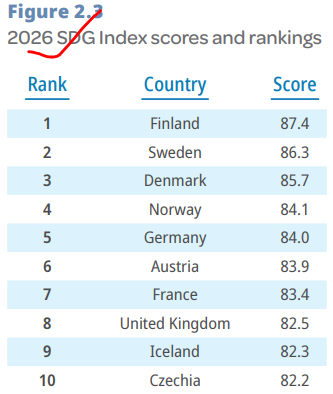
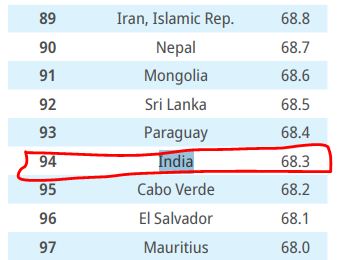
India rose 18 ranks since 2015 to reach its highest-ever position of 94th in 2026 (up from 99th in 2025), but trails Bhutan, the Maldives, Nepal, and Sri Lanka.
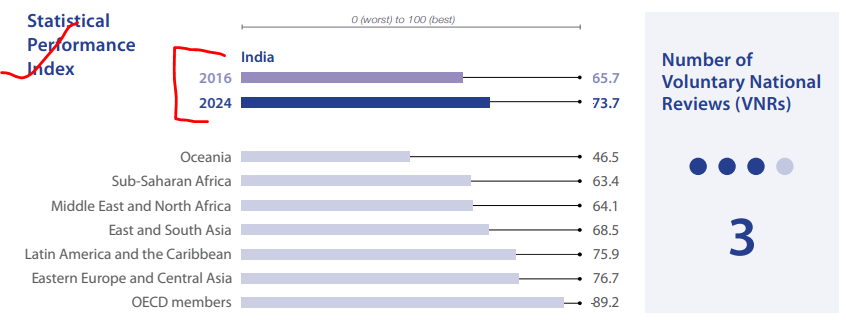
While the UN SDSN releases the global report, India monitors its progress internally through a robust domestic framework:
- NITI Aayog: The nodal agency responsible for implementing and monitoring SDGs nationally via the SDG India Index & Dashboard.
- MoSPI: The Ministry of Statistics and Programme Implementation tracks progress using the National Indicator Framework (NIF).
- Ministry of Panchayati Raj: Localizes the 17 goals at the grassroots level into 9 thematic areas monitored by the Local Indicator Framework (LIF) and the Panchayat Advancement Index (PAI) across 2.5 lakh Gram Panchayats.
So, if this question will come:
According to the updated statistical methodology of the Sustainable Development Report, the newly introduced FAO indicator tracking "Progress towards productive and sustainable agriculture" directly replaces which of the following pre-existing metrics?
- The Global Soil Degradation Velocity Matrix.
- The Sustainable Nitrogen Management Index.
- The Agricultural Greenhouse Gas Intensity Index.
- The Arable Land Nutrient Deficit Score
Answer: (b)
Explanation:
The new FAO indicator directly replaces the "Sustainable Nitrogen Management Index" under SDG 2 (Zero Hunger) to provide a more holistic measure of sustainable farming practices.
<< Previous Next >>